
_WH_800x600px.webp)


Why Upgrade to a 15-30kW Three Phase Hybrid Inverter?
Release time: 2026-05-08
As grid instability and surging utility rates disrupt operations for commercial enterprises and large residential estates, basic grid-tied solar arrays are rapidly becoming obsolete. Generating renewable electricity during the day is simply no longer enough. The real challenge—and the true financial return—lies in managing, storing, and deploying that energy intelligently when the grid goes down or when peak electricity rates spike.
For medium-sized facilities bridging the gap between heavy industrial infrastructure and standard domestic power, conventional consumer-grade equipment drastically falls short. Upgrading to a high-performance Three Phase Hybrid Inverter is no longer a luxury; it is a fundamental engineering requirement. It provides the necessary backbone to secure long-term energy independence, ensure business continuity, and maximize the return on your solar investment.
What Makes the 15-30kW Capacity the Ultimate Sweet Spot?
Choosing the right inverter capacity is critical. If it is too small, the system will overload and trip during startup surges; if it is too large, you face unnecessary capital expenditure and reduced operational efficiency. The 15-30kW power band hits the perfect operational sweet spot for several key applications:
Large-Scale Luxury Villas: Modern high-end residences operate massive HVAC systems, multiple EV chargers, and automated smart home grids. A standard 5kW inverter will immediately fail under these heavy loads, whereas a 30kW system provides ample headroom for peak domestic consumption.
Boutique Manufacturing and Agriculture: Small factories, wineries, and automated farms rely on heavy-duty water pumps, compressors, and conveying equipment. The robust nature of a 15-30kW Hybrid Inverter easily handles the intense inrush currents generated by these industrial motors.
Scalable Future-Proofing: Premium hybrid systems are engineered with scalable capacity in mind. As your facility expands or you add more battery modules, the inverter’s architecture allows for seamless integration without requiring a complete system overhaul.
Why Hardcore Safety and Durability Are Non-Negotiable
When dealing with high-voltage direct current (DC) and massive energy throughput, safety mechanisms cannot be an afterthought. Commercial property owners must mitigate risks associated with electrical fires and equipment degradation.
Military-Grade Environmental Protection: The hardware is built for hardcore industrial environments. Featuring a strict IP66 dust-proof and water-proof grade, these units offer superior protection compared to standard IP65 models. They are fully sealed against heavy rain, corrosive coastal salt spray, and fine industrial dust.
Advanced AFCI and SPD: Fire prevention is paramount. The inclusion of an Arc Fault Circuit Interrupter (AFCI) instantly detects and breaks hazardous electrical arcs before they cause fires. Furthermore, built-in DC side SPD (Surge Protection Device) shields your expensive battery banks and electronics from devastating lightning strikes.
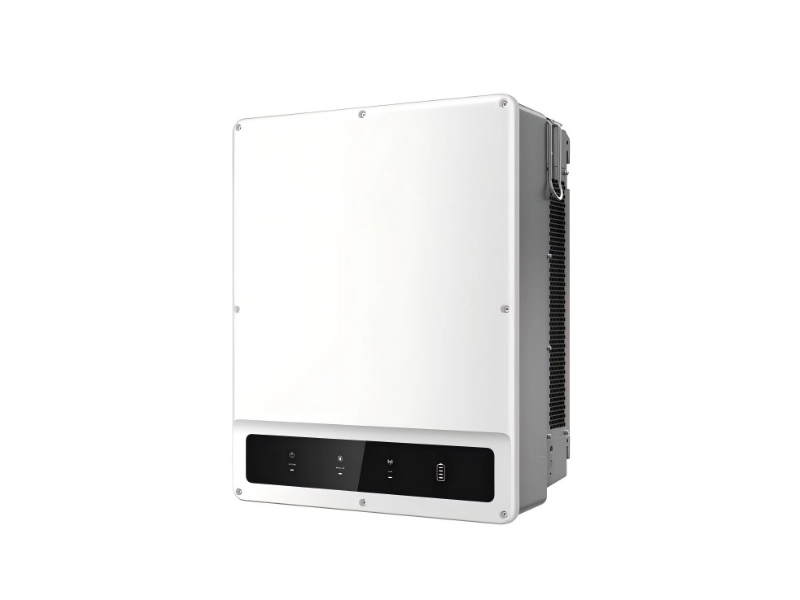
Ultra-Low Noise Design: Despite housing heavy-duty industrial components, top-tier models utilize a silence ultra-low noise design. The sleek, home appliance-style appearance ensures that it can be installed on the exterior of a high-end office building or villa without causing acoustic pollution.
How UPS-Level Switching Guarantees Zero Downtime
One of the most critical failures of a standard grid-tied inverter is that when the utility grid goes down, your solar system is forced to shut down as well to protect utility workers (anti-islanding). This renders your solar panels useless exactly when you need them most.
An advanced Commercial & Industrial ESS Inverter solves this by operating as an uninterruptible power supply (UPS) with battery storage. When a blackout occurs, the system utilizes UPS-level switching—transitioning from grid power to battery power in a matter of milliseconds. This rapid switch is completely imperceptible to sensitive electronics, ensuring that data center servers, security systems, and manufacturing lines experience zero downtime.
| Performance Metric | Standard Grid-Tied Inverter | 15-30kW Hybrid Inverter |
| Outage Response | Shuts down completely | Seamless UPS-level millisecond switching |
| Grid Independence | 100% dependent on grid stability | Full off-grid operational capability |
| Safety Features | Basic breakers | AFCI, DC SPD, and IP66 rating |
| Load Handling | Unbalanced loads cause tripping | 100% unbalanced load support |
| Energy Arbitrage | None (sells back at flat rate) | Intelligent peak shaving capabilities |
Who Benefits from AI-Powered Smart Energy Management?
Hardware is only as good as the software driving it. Modern 15-30kW inverters are integrated with sophisticated SEMS (Smart Energy Management System) platforms, leveraging AI to power smart green electricity.
Industrial Peak Shaving: For C&I facilities, electricity is usually billed with severe peak-hour demand charges. The AI monitors utility rates in real-time, automatically storing cheap solar energy during the day and discharging it during expensive peak hours, drastically slashing operational costs.
Maximizing Complex Roof Yields: Commercial roofs often feature complex geometries, varying angles, and partial shading from HVAC units. Equipped with 2/3 MPPTs (Maximum Power Point Trackers), the inverter isolates different solar arrays, ensuring that a shadow on one string does not drag down the performance of the entire system.
Frequently Asked Questions (FAQ)
Q: Can this hybrid inverter be installed completely outdoors?
Absolutely. Engineered with a rugged IP66 waterproof and dust-proof enclosure, the inverter is built to withstand extreme environmental conditions. It is heavily protected against torrential rain, snow, and airborne industrial particulates without suffering performance degradation.
Q: What exactly is UPS-level switching, and why is it important?
UPS-level switching refers to the inverter’s ability to transition from the main electrical grid to battery backup in milliseconds during an outage. This lightning-fast transfer ensures that sensitive equipment—such as computer servers, medical devices, or continuous manufacturing lines—does not reboot or lose data.
Q: How do 2/3 MPPTs improve my total solar yield?
Multiple MPPTs allow the inverter to independently manage separate strings of solar panels. If one section of your roof is shaded by a tree or a chimney, only that specific string’s output drops. The other arrays continue to harvest energy at maximum efficiency, significantly boosting your overall power generation.